April 2026 Lecturer's Report
Saint John Baptist de La Salle
By Bob Walz, Lecturer for the Council.
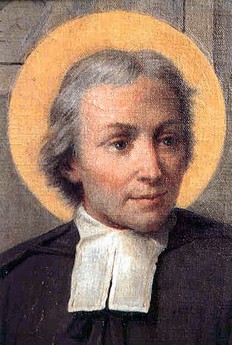
Hero image: Saint Jean-Baptiste de La Salle portrait, via Wikimedia Commons.
Worthy Grand Knight, District Deputy, Officers and Brother Knights,
An Asteroid and a Legacy
Imagine having an asteroid named after you. That would be cool and would cement your name in the heavens for the rest of time.
Edmond Halley is remembered every 75 years when the comet that bears his name reenters our view. He was an English astronomer that realized in 1705 that the comet observed and written about since 240 BC was actually one comet on a continual voyage to our inner solar system.
Now imagine having an asteroid that you can see every day having your name. I bet that would get you invited to a lot of parties. And St. John Baptist de La Salle has that distinction.
1651
Born in Reims, France, on April 30.
1685
Established the first school for training educators in Reims.
1719
Died at Saint Yon, near Rouen, on Good Friday.
Early Life
Let us first get to know him. John Baptist La Salle was born to a wealthy family in Reims, France, on 30 April 1651. He was the eldest child of Louis de La Salle and Nicolle Moet de Brouillet. Nicolle's family was a noble one and operated a successful winery business; she was a relative of Claude Moet, founder of Moet & Chandon.
La Salle was tonsured at age eleven on 11 March 1662, in an official ceremony that marked a boy's intention, and his parents offer of their young sons, to the service of God. He was named canon of Reims Cathedral when he was sixteen, and at seventeen received minor orders to becoming a priest.
At the age of 18, I was graduating from High School without a clue as to what I would become.
He was sent to the College des Bons Enfants, where he pursued higher studies and on July 10, 1669 he took the degree of Master of Arts. When De La Salle had completed his classical, literary, and philosophical courses, he was sent to Paris to enter the Seminary of Saint-Sulpice on October 18, 1670. His mother died on 19 July 1671 and his father on 9 April 1672. These unfortunate circumstances obliged him to leave Saint-Sulpice on April 19, 1672. He was now twenty-one, the head of the family, and as such had the responsibility of educating his four brothers and two sisters. In 1672 he received the minor order of subdeacon, was ordained a deacon in 1676, and then finally completed his theological studies and was ordained to the priesthood at the age of 26 on April 9,1678. Two years later he received a doctorate in theology.
At the age of 18, I was graduating from High School without a clue as to what I would become.
The Schools Become His Life's Work
The Sisters of the Child Jesus were a new religious congregation whose work was the care of the sick and education of poor girls. The De La Salle, just a young priest, helped them become established and then served as their chaplain and confessor. It was through his work with the Sisters of the Child Jesus that in 1679 he met the schoolmaster Adrian Nyel. With De La Salle's help, a school was soon opened. Shortly thereafter, a wealthy woman in Reims told Nyel that she also would endow a school, but only if La Salle would help. She provided the money, as long as La Salle agreed to help run the school. What began as an effort to help Adrian Nyel establish a school for the poor in La Salle's hometown gradually became his life's work.
La Salle became preoccupied with work at the new school. He was aware that teachers needed training and direction, and that the children had few opportunities for success. He calculated that if he lent his talents to the school, and worked with both teachers and students, he could improve their lives.
At that time, most children had little hope for social and economic advancement. Moved by the plight of the poor who seemed so "far from salvation" either in this world or the next, he determined to put his own talents and advanced education at the service of the children "often left to themselves and badly brought up".

Crossing Social Boundaries
La Salle knew that the teachers in Reims were struggling, lacking leadership, purpose, and training, and he found himself taking increasingly deliberate steps to help this small group of men with their work. First, in 1680, he invited them to take their meals in his home, as much to teach them table manners as to inspire and instruct them in their work. This crossing of social boundaries was one that his relatives found difficult to bear. In 1681, De La Salle decided that he would take a further step and so he brought the teachers into his own home to live with him. De La Salle's relatives were deeply disturbed; his social peers were scandalized. A year later, when his family home was lost at auction because of a family lawsuit, De La Salle rented a house into which he and the handful of teachers moved.
La Salle decided to resign his canonry to devote his full attention to the establishment of schools and training of teachers. The priesthood primarily required him to focus on the sacraments and he needed to give full devotion to education, even in his free time to connect with students. He had inherited a considerable fortune, which he could have been used to further his aims, but on the advice of a Father Barre of Paris, he sold what he had and sent the money to the poor of the province of Champagne, where a famine was causing great hardship.
The Christian Brothers
La Salle thereby began a new religious institute, the first one with no priests whatsoever among its members: the Institute of the Brothers of the Christian Schools, also known as De La Salle Brothers in Europe, Australia, and Asia, and the Christian Brothers in the United States. One decision led to another, and La Salle found himself doing something he had never anticipated. La Salle wrote:
I had imagined that the care which I assumed of the schools and the masters would amount only to a marginal involvement committing me to no more than providing for the subsistence of the masters and assuring that they acquitted themselves of their tasks with piety and devotion. Indeed, if I had ever thought that the care I was taking of the schoolmasters out of pure charity would ever have made it my duty to live with them, I would have dropped the whole project. God, who guides all things with wisdom and serenity, whose way it is not to force the inclinations of persons, willed to commit me entirely to the development of the schools. He did this in an imperceptible way and over a long period of time so that one commitment led to another in a way that I did not foresee in the beginning.
La Salle's enterprise met with opposition from ecclesiastical authorities who resisted the creation of a new form of religious life, a community of consecrated laymen to conduct free schools "together and by association". The educational establishment resented his innovative methods. Nevertheless, La Salle and his small group of free teachers set up the institute of the Brothers of the Christian Schools which is, according to the La Salle website, entirely dedicated to the Christian education of the "children of artisans and the poor", in a life close to that of Catholic teachings.
Poverty was widespread in France during this time, and few families could afford to educate their children. La Salle felt the best way to approach this problem would be to establish a community devoted to the education of children, regardless of their ability to pay. He resigned his post as Canon at the Cathedral, left his comfortable family home to live with the teachers, and established the Brothers of the Christians Schools.
Resistance and Success
Not surprisingly, this approach brought resistance from both the secular education system and the Church. The Church was initially opposed to the foundation of an order committed to education, and the secular educators were opposed to the elimination of tuition. They felt it would reduce the prices people would be willing to pay them.
Nonetheless, La Salle was successful. He even expanded his school to offer teaching to young men. In 1685, La Salle established the first school for the training of educators in Reims.
In 1685 La Salle founded what is generally considered the first normal school, a school whose purpose is to train teachers, in Reims.
Worn out by austerity and exhausting labor, La Salle died at Saint Yon, near Rouen, on Good Friday 1719.
Legacy
The good works established by St. John Baptist de La Salle continue today. There are schools following his ideals throughout the world, even in our neighborhood. Although no longer free, the schools hold to his ways and work to instruct young boys and make them into men.
And yes, the asteroid is observable every night. It is not easy to find and it is so far away from us that it poses no threat of colliding with our planet. But still, even popes do not get stars, comets or asteroids named after them. Some astronomer must have attended a La Salian High School and remembered the good fortune he had to be educated by the Christian Brothers.