August 2026 Lecturer's Report
St. Maximilian Kolbe
The story of St. Maximilian Kolbe traces a life of Marian devotion, Catholic publishing, courage under Nazi persecution, and a final act of charity at Auschwitz.
Raymund Kolbe was born on January 8, 1894 in Zduńska Wola, in the Kingdom of Poland, then a puppet state of the Russian Empire. He was the second son of a weaver, Julius Kolbe, and his wife Maria Dąbrowska. His father was an ethnic German, and his mother was Polish. Raymund had four brothers, two of whom died of tuberculosis, Shortly after his birth, his family moved to Pabianice in Poland. In 1903, when he was age nine, Kolbe experienced a vision of the Virgin Mary. He later described this incident:
That night I asked the Mother of God what was to become of me. Then she came to me holding two crowns, one white, the other red. She asked me if I was willing to accept either of these crowns. The white one meant that I should persevere in purity and the red that I should become a martyr. I said that I would accept them both. Remember, he was nine years old.
In 1907, Kolbe and his elder brother Francis joined the Order of Friars Minor Conventual, known as the Conventual Franciscans. The Order of Friars Minor Conventual (O.F.M. Conv.) is a male religious fraternity in the Catholic Church and a branch of the Franciscan Order. In 1910, the Franciscans allowed Raymund Kolbe to enter the novitiate, where he chose a religious name, Maximilian. He professed his first vows to the order in 1911, and his final vows in 1914, adopting the additional name of Maria (Mary).
The Franciscans sent Kolbe to Rome in 1912 to attend the Pontifical Gregorian University. While he was studying at the Gregorian, World War I broke out in 1914. The next year, Kolbe's father, Julius, joined the Polish Legions, a unit in the Austro-Hungarian Army led by Józef Piłsudski. Julius was captured later that year by the Imperial Russian Army and was hanged as a traitor. The news of his father's execution traumatized Kolbe.
Kolbe earned a Doctor of Philosophy from the Gregorian in 1915. Kolbe then continued his studies at the Pontifical University of St. Bonaventure in Rome, where he earned a doctorate in theology in 1919. During this period, he became active in the consecration and entrustment to Mary. While in Rome, Kolbe witnessed vehement demonstrations by Freemasons against Pope Pius X and later Pope Benedict XV. According to Kolbe:
They placed the black standard of the "Giordano Brunisti" under the windows of the Vatican. The "Giordano Brunisti" refers to an anti-clerical, freethinking faction or movement named in honor of Giordano Bruno, the 16th-century Italian philosopher, astronomer, and former Dominican friar. Historically, his followers and later secular movements used his name as a symbol of free thought and rebellion against church authority. Most notably, in the early 20th century, groups identifying with this name participated in intense anti-papal demonstrations in Rome, flying banners that depicted Lucifer triumphing over the Archangel Michael to directly protest Vatican influence.
1894Raymund Kolbe was born in Zduńska Wola, Poland.
1917Kolbe started the Militia Immaculatae.
1941Kolbe died at Auschwitz after volunteering to take another prisoner's place.
Militia Immaculatae
To counter these demonstrations, Kolbe started the Militia Immaculatae, Army of the Immaculate On, on October 16, 1917. This was a group of Catholics who prayed for the conversion of sinners and enemies of the Catholic Church, specifically the Freemasons, through the intercession of the Virgin Mary. So serious was Kolbe about this goal that he added a line to the Miraculous Medal prayer:
O Mary, conceived without sin, pray for us who have recourse to thee. And for all those who do not have recourse to thee; especially the Freemasons and all those recommended to thee.
During this period, Kolbe proposed that the entire Franciscan Order be consecrated to the Immaculate by an additional vow. The idea was well received but faced the hurdles of approval by the hierarchy of the order and the lawyers and was never adopted.
In 1918, Kolbe was ordained a priest. In July 1919, after the end of World War I, he returned to Poland to teach at the Kraków Seminary. The Second Polish Republic had won its independence from the Russian Republic in 1918. While in Kraków, Kolbe was active in promoting the veneration of the Immaculate Virgin Mary. He was strongly opposed to socialist and communist movements that had surfaced in Poland after the war.
In 1922, a recurrence of tuberculosis forced Kolbe to leave the seminary. In January 1922, Kolbe founded the monthly periodical Rycerz Niepokalanej, Knight of the Immaculata, a devotional publication based on the French Le Messager du Coeur de Jesus, Messenger of the Heart of Jesus. From 1922 to 1926, he operated a religious publishing press in Grodno in present-day Belarus. As his activities grew in scope, in 1927 he founded a new Conventual Franciscan monastery at Niepokalanów near Warsaw. It became a major religious publishing center. A junior seminary was opened there two years later.
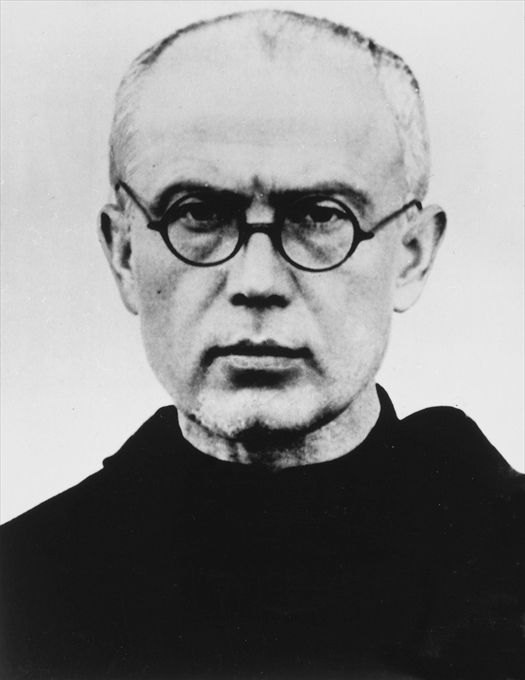
War, Shelter, and Arrest
The invasion of Poland on September 1, 1939 by the German Army signaled the start of World War II. Kolbe was one of the few priests who remained in the monastery, where he organized a temporary hospital. After the Germans captured Niepokalanów, they arrested Kolbe on 19 September 1939. While in custody, Kolbe refused to sign the Deutsche Volksliste, the German People's List. Doing so would have given him rights similar to those of German citizens in exchange for recognizing his ethnic German ancestry. The Germans released him on December 8, 1939.
Upon his release, he continued work at his friary where he and other friars provided shelter to refugees from Greater Poland, including 2,000 Jews whom he hid from Nazi persecution in the Niepokalanów friary. Kolbe received permission to continue publishing religious works, though significantly reduced in scope. The monastery continued to act as a publishing house, issuing a number of publications considered anti-Nazi.
On 17 February 1941, the Gestapo shut down the monastery and arrested Kolbe along with four others. He was incarcerated in the Pawiak prison in Warsaw. On May 28, 1941, the Germans transferred Kolbe to the Auschwitz concentration camp as prisoner 16670.
A Martyr of Charity
Arriving at Auschwitz, Kolbe started ministering to his fellow prisoners. He was subjected to violent harassment by the guards, including beatings and lashings. On one occasion, sympathetic inmates smuggled the wounded Kolbe to a prisoner hospital. At the end of July 1941, a prisoner successfully escaped from Auschwitz. In reprisal, the deputy camp commander, ordered guards to pick ten men to be starved to death in an underground bunker. When selected, Franciszek Gajowniczek, a Polish Catholic, cried out, "My wife! My children!" At that moment, Kolbe volunteered to take his place.
An assistant janitor later testified that Kolbe led the prisoners in prayer from his prison cell. Each time the guards checked on him, he was standing or kneeling in the middle of the cell, calmly looking at those who entered. After the group had been starved and deprived of water for two weeks, only Kolbe and three others remained alive. Impatient to empty the bunker, the guards gave the four remaining prisoners lethal injections of carbolic acid. Kolbe is said to have raised his left arm and calmly waited for it. Maximilian Kolbe died on August 14, 1941. He was cremated on 15 August, which happened to be the feast day of the Assumption of Mary.
The cause for Kolbe's beatification was opened at a local level on June 3, 1952. On May 12, 1955, Kolbe was recognized by Pope Pius XII as a servant of God. Kolbe was declared venerable by Pope Paul VI on 30 January 1969 and beatified as a confessor of the faith by the same pope in 1971. The miracles used to confirm Kolbe's beatification were the July 1948 cure of intestinal tuberculosis in Angela Testoni and the August 1950 cure of calcification of the arterial sclerosis of Francis Ranier. Both individuals attributed their cures to Kolbe's intercession by their prayers to him.
Kolbe was canonized by Pope John Paul II on October 10, 1982. The pope declared him as a confessor and a martyr of charity. Franciszek Gajowniczek, the man Kolbe saved at Auschwitz, survived the Holocaust and was present as a guest at both the beatification and the canonization ceremonies. These events have all taken place during most of our lifetime. The fact that Franciszek Gajowniczek was able to attend the beatification and canonization ceremonies must have been very moving for all in attendance.